
The author of the book “Midnight’s Children” did not set out to write a crowd pleaser, but rather wanted to create a work that focused on the India he knew growing up in Bombay. Salman Rushdie said he never begins to write with the reader in mind—something he acknowledged as “a terrible, horrible admission.”
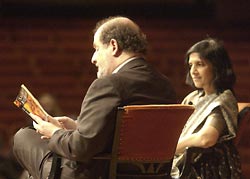
His remarks were made during a dialogue about the book, now adapted into a play, which made its U.S. premiere at the Power Center last week during the Michigan residency of the Royal Shakespeare Company (RSC).
“My process, as a writer, is to be the servant of the idea,” Rushdie said during one of the more than 70 educational programs of the RSC residency. “Writing is about opening the doors of perception.”
The idea, in this case, was that India is a crowd, Rushdie told the audience. “How do you tell the story of a crowd? How do you tell the story of a multitude? The central narrative has to push its way through the crowd.”
Gauri Viswanathan, Class of 1933 Professor in the Humanities and director of the Southern Asian Institute at Columbia University, interviewed Rushdie as part of a two-day event featuring the artist-in-residence March 11-12. Viswanathan praised “Midnight’s Children” as a book that spoke to the Indian people. She quoted a friend who came to her with it and said, “‘You have to read this. It’s about us.'”
Rushdie is credited with starting a new genre of books about India, in what Viswanathan called a rebellion against an earlier tradition of writing. An April 19, 1981, New York Times review by Clark Blaise characterized the contrast between earlier works about India with “Midnight’s Children”: “What this fiction has been missing is a different kind of ambition, something just a little coarse, a hunger to swallow India whole and spit it out.”
Rushdie said he was compelled to write something different. “Yeah, I did feel that what existed, certainly in English at that time—good as much of it was—didn’t speak to me about the world I knew, the world I’d grown up in,” Rushdie said. “The very manner of the novels was very calm, mild, classicist—kind of linguistically orthodox. And I just thought, India’s not like that. India’s turbulent and noisy and vulgar and crowded and unorthodox. It’s a racket and it’s a sexual assault—it’s all of these things.”
Rushdie also admitted that part of his inspiration for writing came from rebellion against his father, a theme he included in “Midnight’s Children.” “When I told my father I wanted to be a writer, he said, ‘What will I tell my friends?’ I had to prove to him and to myself that this business of becoming a writer was worth doing,” he said.
Rushdie participated in three events during the two-day visit to campus. In a session titled “The Political Rushdie,” the author charmed the audience in a wide-ranging conversation with Ashutosh Varshney, director of the Center for South Asian Studies (CSAS). Rushdie addressed the limits of free speech (“Democracy is not a polite business”), his assessment of Pakistan (“The institution of democracy has never been allowed to take root”), and the role of politics in fiction writing (“I always wanted to write a novel that wasn’t political. I thought the ‘Satanic Verses’ was it”).
Finally, Rushdie took part in an international symposium sponsored by CSAS, “Knowing South Asia: Reflections on the World of Salman Rushdie.” Panelists included Juan Cole, professor of history; Sunil Khilnani, director of the South Asia Program at The Johns Hopkins University; Shashi Tharoor, executive assistant to Kofi Annan, the secretary-general of the United Nations; Husain Haqqani, former Pakistani ambassador to Sri Lanka; Sara Suleri Goodyear, professor of history at Yale University; and Varshney.
