
Women at the University continue to make progress in employment, retention and enrollment, but U-M still has more to accomplish to achieve gender equality, President Mary Sue Coleman said, citing a new report, “Women at the University of Michigan: A Statistical Report on the Status of Women Students, Faculty and Staff on the Ann Arbor Campus.”
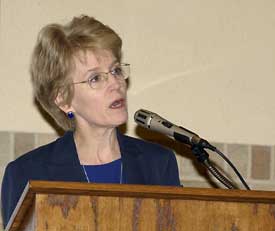
The report, highlighted during an open forum at the Law School Oct. 2, enables the University to step back and take a close look at progress—or lack thereof—in fully incorporating women into the fabric of University life, and assists with creating a roadmap to gender equity, Coleman said. The data were collected in 2001 and follow three earlier reports produced in 1992, 1993 and 1996.
“We have made significant progress on the status of women in tenured faculty positions, and the number and proportion of women in executive leadership positions at Michigan, both academic and administrative, is nationally distinctive,” Coleman said. “The number of undergraduate, graduate and professional degrees granted to women continues to grow, although much work remains to be done in recruitment and retention of women students of color.
“The numbers are not as good when we look at the assistant professor data, and at our ability to draw adequately from the national pool of available Ph.D.s. In both the faculty and staff ranks, it is clear we must work to improve the representation of women of color at all levels,” Coleman said.
Carol Hollenshead, director of Center for the Education of Women (CEW) and initiator of the report, said, “The report provides many indicators of progress toward achieving gender equity, but it also identifies areas where change has been hard to achieve. In the decentralized U-M environment, data from this report will serve as a valuable tool for individual schools and departments across campus, as well as for the University as a whole.”
Highlights include:
• In 2001 women held 50 percent of executive officer positions and 47 percent of dean posts. Women account for 28 percent of department chairs, compared to 16 percent in 1995;
• The percentage of women at higher salary grades (grade16 and above) increased from 30 percent in 1995 to 41 percent in 2001;
• Women earned 51 percent of the bachelor’s degrees granted by the University in 2001, up from 48 percent in 1995. Also increased were the percentage earning master’s degrees (now 46 percent) and professional degrees (now 45 percent). Women earned 39 percent of doctorate degrees, up from 34 percent in 1995;
• The percentage of women holding tenured and tenure track faculty positions rose since 1995. Women make up 17 percent of all full professors, up from 12 percent in 1995, with women of color representing 2 percent. Women account for 34 percent of all associate professors, up from 26 percent in 1995, with women of color representing 7 percent.
Despite significant gains in some areas, the University still can make improvements, the study indicates. Examples include:
• Women continue to make up about one-third of the assistant professors (34 percent), a figure that has been virtually static for more than 20 years. Although the pool of women with doctorate degrees has increased dramatically in the last 30 years, the University’s percentage of women faculty continues to be at or below the 1979 national levels of doctorate degrees attainment in nearly all academic disciplines;
• Among staff, women are clustered at the lower ranges of compensation in most job families. The proportion of women of color continues to be highest in the service/maintenance jobs (26 percent) as opposed to 16 percent in the office job family and 12 percent in the professional/administrative ranks;
• Among non-tenure track faculty, women make up 57 percent of lecturer positions. The number of lecturers grew by more than one-third between 1990 and 2001, and women accounted for 82 percent of that increase, meaning that in percentage terms, the largest increase in faculty women occurred off the tenure track.
Coleman said the climate for women in the University must continue to improve at every level. “Faculty hire faculty,” she said, so changes in hiring must reach beyond deans and department directors. She also said women faculty should be made aware of programs such as the tenure-clock-stop, which allows them to get off the timed tenure track temporarily to have children or for other life events. Coleman said many women don’t know about the program and others are afraid to use it for fear their careers will be impacted negatively.
Coleman also said women need to feel the University provides a good quality of life, including one that is free of sexual harassment and sexual assault. She highlighted recent initiatives to promote awareness on campus.
The current report, like its three predecessors, was prepared under the auspices of the President’s Advisory Commission on Women’s Issues (PACWI) by CEW, Human Resource Records and Information Services, and the Office of Budget and Planning.
Since the late 1980s, PACWI and other U-M women’s groups have organized community forums as a means for U-M presidents to address women’s concerns.
To read the report visit http://www.umich.edu/~cew/PACWI.html .
