
While many native civilizations in the Western hemisphere have been absorbed into the mainstream of the modern world, the Huichol people of Mexico have maintained their traditional culture, language and spiritual way of life for centuries.

The harsh environment of the Sierra Madres has isolated the Huichol from the effects of invading Spaniards, and phenomena, such as mass industrialization. But that physical isolation may not be able to stem the tide of the information and technology revolutions.
While the Mexican government advocates running electrical lines into the mountains, the Huichol are not eager for technology that brings with it deforestation, road construction and video games. They want access to technology, but on their own terms.
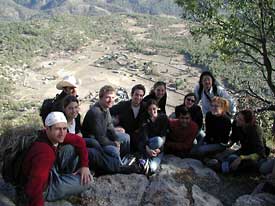
During spring break 2005 Keith Van Der Sys, a lecturer in architecture, along with visiting professors Sheila Kennedy and Frano Violich, and 13 architecture graduate students, embarked on a journey into this rugged and remote terrain to meet the Huichol people, and perhaps discover simple design solutions that might help these indigenous people sustain their culture, while improving their economic viability for the 21st century.
There, the visitors confronted a series of paradoxes: how to address the need for electrical power with a portable source, since the Huichol are a semi-nomadic tribe; and how to integrate technology into the lives of the Huichol while maintaining the integrity of their culture. Descendants of the Aztecs, the Huichol remain rooted in ancient customs, including very robust textile, thatch and wood-braiding traditions. These traditions became the key to inventing solutions that could bring the sun into their nights with solar technology.
Students took a careful, pragmatic approach that considered how daily life in the “third world” can be improved by designs that integrate high brightness light emitting diodes (HBLED) and photovoltaic technology; and how technology can be improved by imposing on it a very rigid set of restrictions. The studio brainstormed as a group, identifying design concepts to provide access to solar power. They then broke into teams of three or four students to develop, refine and fabricate prototypes.
Working directly with HBLED and photovoltaic materials, they created a collection of full-scale prototypes for energy-harvesting textiles—a radically sustainable new form of flexible infrastructure. High brightness semi-conductors (HBLEDs) are woven into textiles to create digital light—a new form of energy efficient illumination. These included a community bag, portable workshop, portable storefront and a reading stool.
These concepts aimed to easily be incorporated into their daily routines, such as a haversack, or portable workshop, that mirrors traditional Huichol apparel. The haversack contains solar collectors in the strap where it hangs over the shoulder. At the end of the day, the components can be reconfigured and the solar energy used to power lights contained in each component. With extra hours of light, the Huichol children can learn to read, and the adults can engage in beadwork and other crafts that are important to their economy.
Back in Ann Arbor, the studio extended its explorations to examine ways to integrate solar collectors into textile-reinforced concrete construction (TRC), a sustainable, affordable and lightweight building technology. Structures made of TRC would expand advantages for the Huichol by providing light for nighttime tasks and creating energy to facilitate the use of cellular phone communication that could boost the economic development of Huichol agriculture and crafts businesses.
The work of the Nomads and Nano-materials studio was selected for WIRED magazine’s NextFest 2005 exhibition, the only project selected from a school of architecture. NextFest, which took place June 24-26 in Chicago, showcased the best emerging new technologies and design concepts. The dean’s office also has underwritten summer safaris for a team of students to continue working on the project.
