
To poets, the stars, moon and sun may be a source of inspiration, but to people whose livelihoods depend upon properly timed planting, harvesting and hunting, celestial bodies long have been a valuable source of information.
People throughout Africa, for example, relied on the Pleiades star cluster to tell them when it was time to till the soil and when the growing season was about to end. The Zulu and the Xhosa followed the moon’s phases as well, postponing important decisions until the full moon, when all natural forces were thought to be strongest.
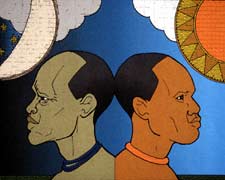
“The People and Their Sky,” a program presented to four sold-out audiences at the Exhibit Museum of Natural History planetarium on Martin Luther King Jr. Day, explored African and African American legends and lore about the sun, moon, stars, lightning and thunder. In one tale, Sun and Moon were brothers who both wanted to marry the same beautiful woman. On their way to her village, located in a forest filled with fierce creatures, Moon became frightened and ran away. Brave Sun then won the woman’s hand, sending his brother into a fit of jealousy. That, as the story goes, explains why Sun and Moon avoid each other to this day and why Sun is far more brilliant and important than his pallid brother.
The sky took on new significance to African Americans in the days of slavery, with the North Star, Polaris, pointing the way to freedom. The planetarium show, researched and developed by planetarium director Matthew Linke and students in the Undergraduate Research Opportunities Program, also explains how passing along stories about the sky helped keep African and African American wisdom and traditions alive over centuries and through times of extreme hardship. Because this occurred mainly through oral story telling, researching the program was challenging, Linke said. One student, American Culture major Jeremy Spoon, who had lived for a year with the Maasai of Kenya and Tanzania, was particularly passionate about the project.
“Jeremy was really a driving force,” Linke said. “He helped bring it all together, and through his own drive was able to find material that we hadn’t located from any other source.”
In addition to being shown for the past five years at the Exhibit Museum planetarium to commemorate MLK Day, the program has been shown at other planetariums around the state and is available to groups year-round.
