
By Jane R. Elgass
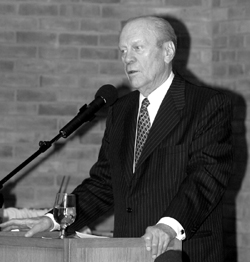
Four members of former President Gerald R. Ford’s administration gathered at the Ford Library on North Campus on Sept. 12 to discuss “Policymaking in the Ford Years and Beyond.” The panel followed a morning ceremony in Hill Auditorium that made official the naming of the Gerald R. Ford School of Public Policy.
The informal presentations and discussion were moderated by President Lee C. Bollinger, following opening remarks by Ford.
Prior to leaving to give a pep talk to the Wolverine football team (he was a member of the team when a student here), Ford said the panelists were “excellent representatives” of his administration who could give the audience a look behind the scenes, where most of the work goes on.
He also noted that the Ford Library would not be at the U-M “without the very constructive work” done by President Emeritus Robben W. Fleming and Robert Warner, University historian, former U.S. archivist and dean emeritus of the School of Information and Library Studies. The two were instrumental in the U-M being named the site for the Library and in scrambling to find a temporary home when many of Ford’s papers initially were released in 1977.
“The Library is a great repository,” Ford said, noting that the release last April of 25,000 documents related to the fall of Saigon has prompted a “tremendous increase in the research being done on that era.”
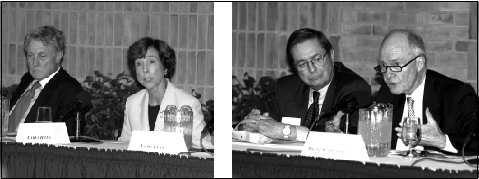
Panel members were James M. Cannon, assistant to the president for domestic affairs in 1974–76; Carla A. Hills, secretary of Housing and Urban Development in 1975–76; James T. Lynn, director of the Office of Management and Budget in 1975–76; and Gen. Brent Scowcroft, assistant to the president for national security affairs in 1974–76.
Scowcroft sees a “dramatic departure” when comparing the policy framework of the Ford administration to today’s administration. It is a different foreign policy arena, he noted. The Ford administration came in when the nation was in the depths of the Cold War, devastating nuclear attack was possible with 30-minute’s notice. There was a fear that technological advancement in the Soviet Union would surpass that of the United States, detente had disintegrated, there was a serious erosion of the office of the president in the aftermath of Watergate, the Vietnam War was ending, and calls came from Congress to reorder priorities.
“We struggled just to keep our heads above water,” he said.
“In many ways, it was a simpler world,” where the bad people wore black hats and the good wore white hats. That world has disappeared, he noted, and since the country does not feel threatened, “we don’t care about foreign policy.” The world has been released from the Cold War, and it is a “messy, complicated world” in which the hats are now shades of gray and foreign policy is run by the media, producing an “error-conducive” environment.
It is a world in which faster communications and the quick flow of capital across national boundaries has increased globalization, but one in which it “is difficult for a president to control vital areas of the country’s life.”
There is political breakdown, he said, evident in small, autonomous groups. Intervention in world affairs has become an issue of values versus national interest debated on a national level, an environment in which policy is harder to define.
Lynn is struck by both “change and lack of change.”
“First-rate analysis of government programs continues, and good analysis will always make someone angry,” he said. But the relationships are different. “The tensions in Congress are worse as time goes by. It’s like dealing with two boards of directors, one with 435 members and one with 100 members.”
The nation’s forefathers wanted tension between the legislative and executive branches, but there is no place to go to make a deal today, nobody on the Hill to do this with. “There are times when I wish patronage were back. Parties have ceased to be as important,” with candidates relying on soft money, “and there are splinter groups for every issue, each with their own war chests. Over time, this affects a lot of votes. I don’t like what I see, but I have no idea what to do. The relationship with the Hill is not one of camaraderie.”
Lynn also feels there is a “void of knowledge” among the American people, partly due to important issues getting short shrift on television, for example. “One of the biggest problems to solve is how to get people to learn more, to increase the knowledge of the American people. It is a critical thing to work on.”
Hills noted that the era of the Ford administration was one in which confidence in big government had begun to recede, driven by Washington intervention. Ford, she said, worked steadily “to move power out of Washington to the states.” Accomplishments in that arena included a housing act that gave communities block grants with no strings attached and housing vouchers for people to rent, not just build new homes.
The 1974 trade act that created a fast-track procedure—a compact between the president and Congress under which Congress could not amend a trade bill if it agreed to let the president handle negotiations—opened global markets, added to competition and raised the standard of living.
“It was quite amazing,” she said. Ford was in office only 29 months, but had “a huge impact on policy, leaving an indelible mark on government in reinforcing tried and true policies.”
Noting that “policy always reflects the nature, character and personality of the president,” Cannon cited his first policy decision—about a science adviser to the president, which came up shortly after he assumed his position.
“I had never written for an audience of one,” he said, but was asked by Ford to find out who prior advisers had been and what they accomplished. Ultimately he recommended an adviser, small staff and $1 million annual budget.
Ford felt this decision “should be a matter of legislation, that it was important for Congress to be involved. It took almost a year to do. It was a good, sound decision, considered carefully.”
“With Ford, Cannon added, “everybody had a chance to be heard. He would look in the faces of people and hear their professional point of view. It ought to work this way.”
Bollinger asked the panelists to address issues they raised about the speed of communication today and its impact on public policy formation.
The public is less informed and partly less interested, Scowcroft said. If the polls show the media there is no interest in an issue, the media cuts coverage. “This is undoubtedly true in foreign policy. The American people are drowning in information and this does make a difference.”
If you are the president and “the press is screaming at you, you face the pressure of an immediate decision.” This even has an impact on what crisis receives attention, and “creates a serious distortion of policy.”
Hills noted that while the public is “suffocated with information” and may have trouble distinguishing fact from fiction, you can know “with the click of a mouse what is going on. This creates greater discipline. The movement of $1.5 trillion around the world each day has been fostered by instant communication.”
Cannon sees less understanding of what is going on, citing specifically the decline of newspapers carrying in-depth coverage of issues and the fact that television is seen as entertainment.
Asked about a possible conflict between politics and making good policy, Lynn said the scene hasn’t changed much. “The urgencies of getting your way for re-election affects policy. We need to keep politics out of basic policy analysis, but it is still a consideration.”
Compromises are critical to getting the job done, he said, but they are being done too early in the process now, resulting in watered-down bills.
“The hardest thing today,” he noted, “is to get older people into government. There is always the risk of destroying your reputation, worse than ever before. Why leave a good job?”
Specifically addressing trade issues, Hills noted that during the Ford administration there were 27 signers of GATT, the General Agreement on Tariffs and Trade, which was initiated by the United Nations in 1948. Today, 137 nations are in the World Trade Organization, and the addition of China would make 138, with 30 in the queue. “It is much more complicated. The United States simply has to be a leader in trade,” she said, adding that “we need fast-track again. We’re not there to shape and protect our own interests. We need to lead. We are the best equipped, we are everywhere. We can lead by example, but have failed to do that recently.”
