
February is national Children’s Dental Health Month and a new study from the School of Dentistry shows that health care professionals, teachers and parents need to pay closer attention to a child’s oral health, as it plays a major role in their general health, quality of life and academic achievement.
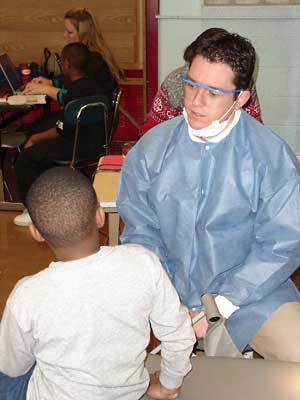
For the past two years, Associate Professor of Periodontics and Oral Medicine Dr. Marita Inglehart and colleagues from the School of Dentistry and the Department of Pediatric Dentistry at Mott Children’s Health Center in Flint have collected data from nearly 4,000 students at 35 kindergarten and elementary schools in Flint and Genesee County.
They found that more than half of the students had untreated caries, or cavities. Another 10 percent had abscesses and/or “pulpal involvement”—a condition where the cavity was so deep that it went into the nerve of the tooth. More than 17 percent of the children said they had a toothache the day of their oral exams; 35 percent said they had pain when they ate something hot or cold; 31 percent had pain when they chewed; and 23 percent reported pain when they ate something sweet.
“There’s a tendency to think that if children don’t complain, then there is no pain, and nothing is wrong. But we’re finding that’s not the case,” she says. “Our study shows that many of these children have major oral health problems that affect their quality of life. That, in turn, affects their ability to learn in the classroom, make friends, or get along with other students their age.”
Twenty percent of the children said a toothache kept them up at night; 13 percent said the pain kept them home from school; and nearly 20 percent said discomfort made it difficult for them to pay attention in the classroom.
“Those pains showed clearly how strongly poor dental health affects their lives in general and, specifically, their ability to achieve academically,” Inglehart says. “These findings allow us to help teachers recognize how poor oral health problems can affect student learning.”
But the problems are more than academic. They also appear to be social, Inglehart says.
“Children with bad oral health usually don’t smile and have a poor self image,” she says. “When that happens, it’s more difficult for them to make friends and may even make them more liable to be picked on by others.”
Inglehart says two findings from the study surprised her—how many children share a toothbrush and the number of children with jaw joint (TMJ) problems.
She said nearly 20 percent of kindergarten students share a toothbrush with another member of the family. The percentage dropped to about 19 and 15 percent, respectively, by the second and third grades. Not surprisingly, she says, children who shared toothbrushes had poorer oral health than children who did not.
“We learned that more than 20 percent of five year olds said they heard clicking when they chewed on the side of their mouth or opened their mouth wide,” she says. Those problems could result from rough play or receiving a blow to the back or side of the head.
When the study is completed, Inglehart hopes to use the findings to give teachers, physicians, nurses, social workers and others new tools and information to help children get the oral health care services they need.
“I also want to see more parents actively involved in the oral health care of their children, especially young, first-time mothers who are 23 years old or younger so that they clearly understand how important good oral health is to their child’s general health, their quality of life and, indeed, their academic success,” she says.
U-M collaborators with Inglehart were Dental School faculty members Drs. Robert Bagramian, Tilly Peters and Sven-Erik Widmalm, and Dr. Elizabeth Moje from the School of Education.
