
A collection of four exhibits titled “Landscapes of Longing: Journeys Through Memory and Place,” on display at the U-M Museum of Art (UMMA) Jan. 21-Apr. 2, will illustrate how an artist’s vision of landscape has the ability to be shared in a community, as the memory transcends time.
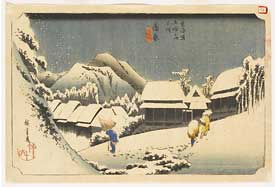
The four featured exhibits include “Andô Hiroshige’s 53 Stages of the Tôkaidô”; “Hiroshi Sugimoto: Time Exposed”; “The Idyllic Retreat in Chinese Landscape Painting”; and “Passage to Angkor: Photographs by Kenro Izu.” The exhibits contain portrayals of early modern Japan, Cambodian temples of Angkor, mountains in China and seascape photographs.
“This provocative suite of exhibitions is truly greater than the sum of its parts,” UMMA Director James Steward says. “Cumulatively these master artists challenge us to think about how we know what we think we know about the physical world around us, and thus about the basic power of art.
“Thanks to major sponsorship from the Ford Motor Company Fund and from our other generous funders, we are able to present these renowned artists in provocative new company.”
Hiroshige’s works, published in the 1830s, are woodblock prints of the Tôkaidô—Japan’s great coastal road. The entire original set of the “53 Stages of the Tôkaidô” rarely has been displayed all at once as it will be at UMMA. In fact, the exhibit on loan from the Allentown (Pa.) Art Museum has been shown publicly only once.
“We are bringing together four very different exhibits in terms of material and nationality, but each is a vehicle of expression of longing,” says Maribeth Graybill, UMMA senior curator of Asian art. “They deal with a deep sense of loss. They suggest a sense of something wonderful that was there but is not anymore.”
“Time Exposed” includes 50 seascapes from around the globe by Sugimoto, on loan from the Museum of Contemporary Art in Chicago. “Using the same materials, water and air, I just amaze myself at how I see things differently and new,” Sugimoto says. “So I have to keep investigating.”
Works by many artists from the Ming- and Qing- periods of China (14th to early 20th centuries) make up the “The Idyllic Retreat in Chinese Landscape Painting.” All of the depictions come from the UMMA collection and many will be shown publicly for the first time.
The photographs by Izu feature the stone temple mountains of ancient Cambodia, ravaged by centuries of neglect. His exhibit, “Passage to Angkor,” will be on display for the first time in the State of Michigan.
“It’s been awhile since we had a major focus on Asian art,” Graybill says. Since one-fourth of UMMA’s collection is Asian art, organizers wanted to return to Asia but desired a multi-national, thematic collection to exhibit. “These have the ability to evoke universal, human emotion,” Graybill says.
She says the exhibits will appeal to a very broad audience, from art historians to the general public to University students. “These exhibits are tremendous fun and not intimidating at all,” she says.
