
When Stacey Davis Stewart graduated from the Business School, she knew she had a tough road ahead of her. Her future in investment banking and public finance certainly would be challenging, and Stewart knew she wouldn’t get anywhere if she identified herself primarily by gender.
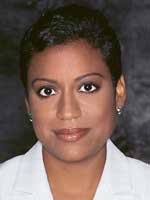
“We can’t be defined by any of the expectations of our gender. I believe that if we’re going to be defined by anything, it shouldn’t be titles or positions, it should be our values,” Stewart said Oct. 10 when she was one of two keynote speakers at the Business School’s Women in Leadership Conference. The other speaker was Carol Gallagher, president and CEO of the Executive Women’s Alliance, a leadership development firm.
Stewart is the president and CEO of the Fannie Mae Foundation, a nonprofit organization that creates affordable housing opportunities for city neighborhoods across the country. Stewart closed this year’s conference with an address to many young women who have to face the business world as women dealing with gender expectations.
For Stewart the struggle began in 1987, when she received her MBA with a concentration in finance from the Michigan Business School after earning a degree in economics from Georgetown University.
“Michigan has its own place in the world and its own place among Business Schools that is very special,” she said. “I think the thing that is really important about Michigan is that it does blend all the things that are really important in terms of a business career, in terms of a perspective on life.”
Stewart described the setting where she first realized what she wanted to do with her MBA. Seated in Hale Auditorium, the site of her Oct. 10 speech, Stewart listened to a group of alumni speak about investment banking. When one of the men mentioned public finance, her future path in the business world became clear.
“They were all talking about corporate finance and mergers and acquisitions and leveraged buyouts—all this stuff that I really wasn’t that interested in. But there was this one guy who was talking about the possibility to use capital to do good and create social change, and that guy really inspired me,” she said.
With her degree and an eagerness to help her community, Stewart began working with Merrill Lynch as an investment banker in the public finance division.
“As I looked back on my experience, starting on this campus and then leading to my first job,” she said, “I think all of the essential principles of leadership were in place: take risks, work hard and expect adversity but above all else, find your passion and act on it.”
And act she did, moving to the investment banking firm Pryor McClendon Counts as vice president three years after she began working for Merrill Lynch. She always knew she was good with numbers but felt that her passion to help her community was too strong to ignore. This passion led her in 1992 to the Fannie Mae Foundation, where she learned more about leadership.
“You can’t decide what you want to do with your life until you find out what it is you care for, what it is you’re willing to sacrifice and what it is you’re willing to work hard for,” Stewart said. “I think once you have identified your passion, everything else falls into place.”
Fannie Mae’s mission is to make affordable housing and community development a reality for millions of people. Stewart became president and CEO in 1999 and continues to create programs in which technical knowledge and financial resources are available to all communities, and families acquire their own homes.
Her education gave her a jumping-off point from which she could begin her career, helping communities to be havens for families across the nation, she said. With all her accomplishments in the business world as well as her community, Dean Robert Dolan described her as one of the Business School’s “most prestigious alums.”
Stewart said, “I think the lesson that I learned most is the lesson that when you have completed your coursework here that’s when your education really begins. It’s really once you’ve been granted that degree and you’re ready to move on in your life. My professors here really encouraged me to remember that the most appropriate feature of higher education is that it ends with a commencement ceremony but the ending is really a beginning.”
