
Seven U-M students who participated in a new research exchange program this summer with Peking University in Beijing expected to learn about chemistry.
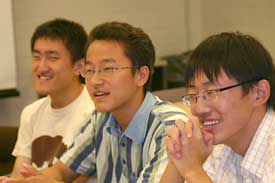
But the students — three from the University and four from PKU who participated in the pilot program — also gained greater understanding of their host countries’ cultures.
The new program is part of President Mary Sue Coleman’s China initiative to develop academic partnerships with PKU and Fudan University in Shanghai. The students worked alongside other researchers in their host countries and also had the opportunity to form personal and professional relationships that will enrich their perspectives on chemistry and the world.
The students recently gathered at the Chemistry Building with Professor Brian Coppola, a co-director of the program, to discuss their experiences.
Wei Wang, a second-year PKU chemistry major, worked with professor James Penner-Hahn studying metal deposits in zebra fish eggs. Although he is fluent in English, he said he seldom spoke it before coming to Ann Arbor.
Wang, who is accustomed to walls surrounding the PKU campus, found U-M peaceful and quiet. He spent part of his time living with a Chinese family in northeast Ann Arbor and traveled to Chicago to visit museums.
“The U-M PKU program provided me with a great experience in American culture,” Wang said. “Now I know a little bit. I would certainly like to come back.”
Xiaowen Feng, a second-year PKU chemistry major, conducted research with Professor Vincent Pecoraro involving magnets.
“I liked to see the research conditions between China and America,” Feng said. “You have a lot of good machines. In China we have some but you have a lot.”
Feng also enjoyed weekend barbecues and other social activities in Ann Arbor, and said he developed a taste for buffalo chicken wings. “In China we do not have so many parties,” Feng said. “Here they have parties every weekend and that’s good.”
Justin Lomont, a U-M senior chemistry major, said communicating in Chinese was difficult, despite a two-week course in the language as part of his PKU orientation.
“I wish I had learned more Chinese,” Lomont said. “I had not lived in another country before. It was really cool. The experience makes me want to travel more and understand how people are thinking and feeling without using language.”
Lamont will lead a discussion group of U-M freshman this fall about the book “China Shakes the World” by James Kynge as part of LSA‘s China Now Theme Year.
Tiffany Chen, a junior chemistry student, said she was looking forward to reconnecting with her Chinese heritage during her stay at PKU. “I learned a lot about China that I never knew before,” Chen said. “I had the standard American perceptions that Chinese people work very hard. But it’s more of a lifestyle. Lab schedules in China went from 8 a.m. to 8 p.m. Sunday to Friday, but that included breaks, lunch and nap times.”
She also noticed two-thirds of the students at PKU were men and that everyone she met spoke English.
Coppola said cross-cultural education lays a foundation for future exchanges.
